America's Strategic City: Inaugural Forum
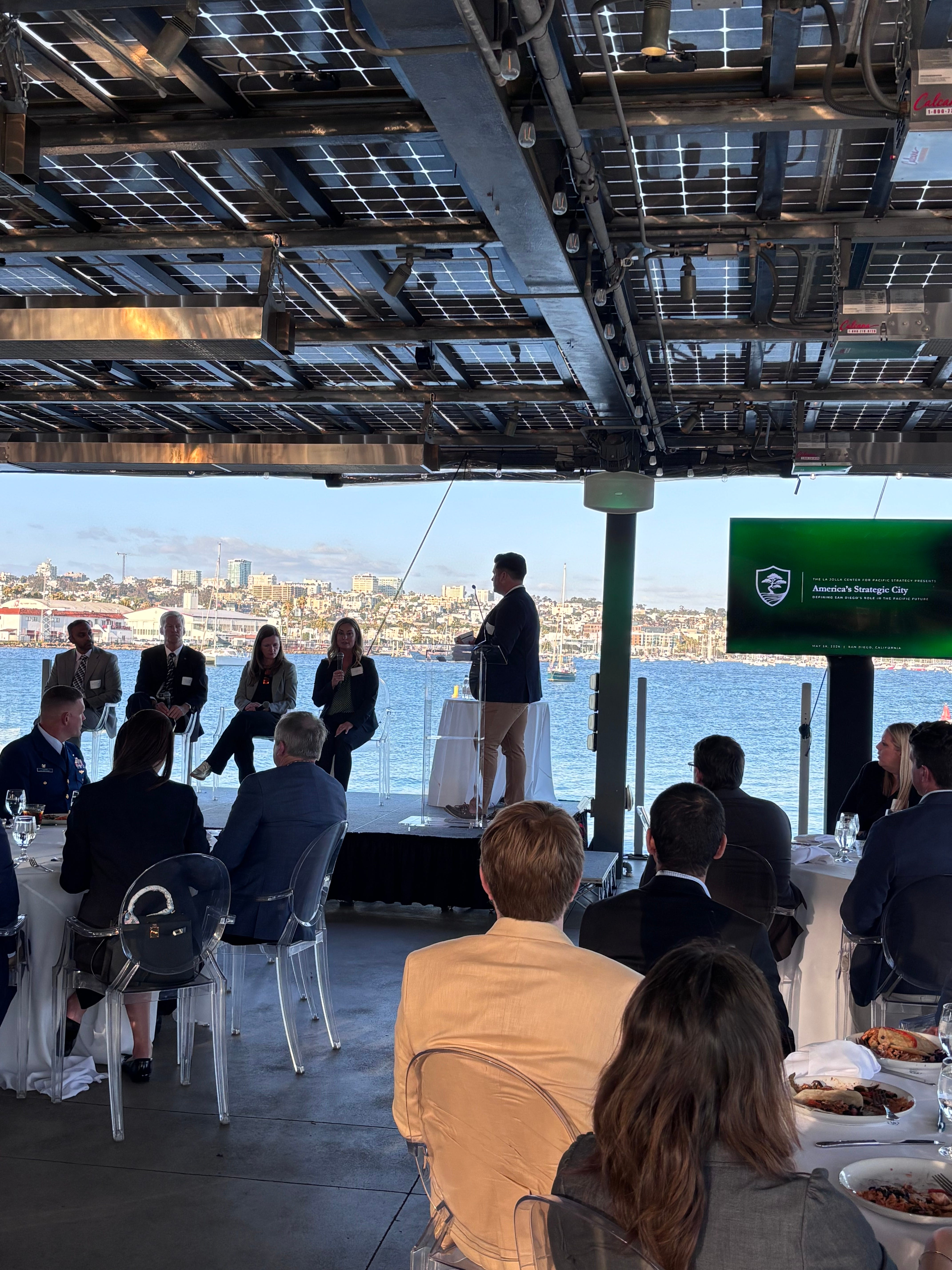
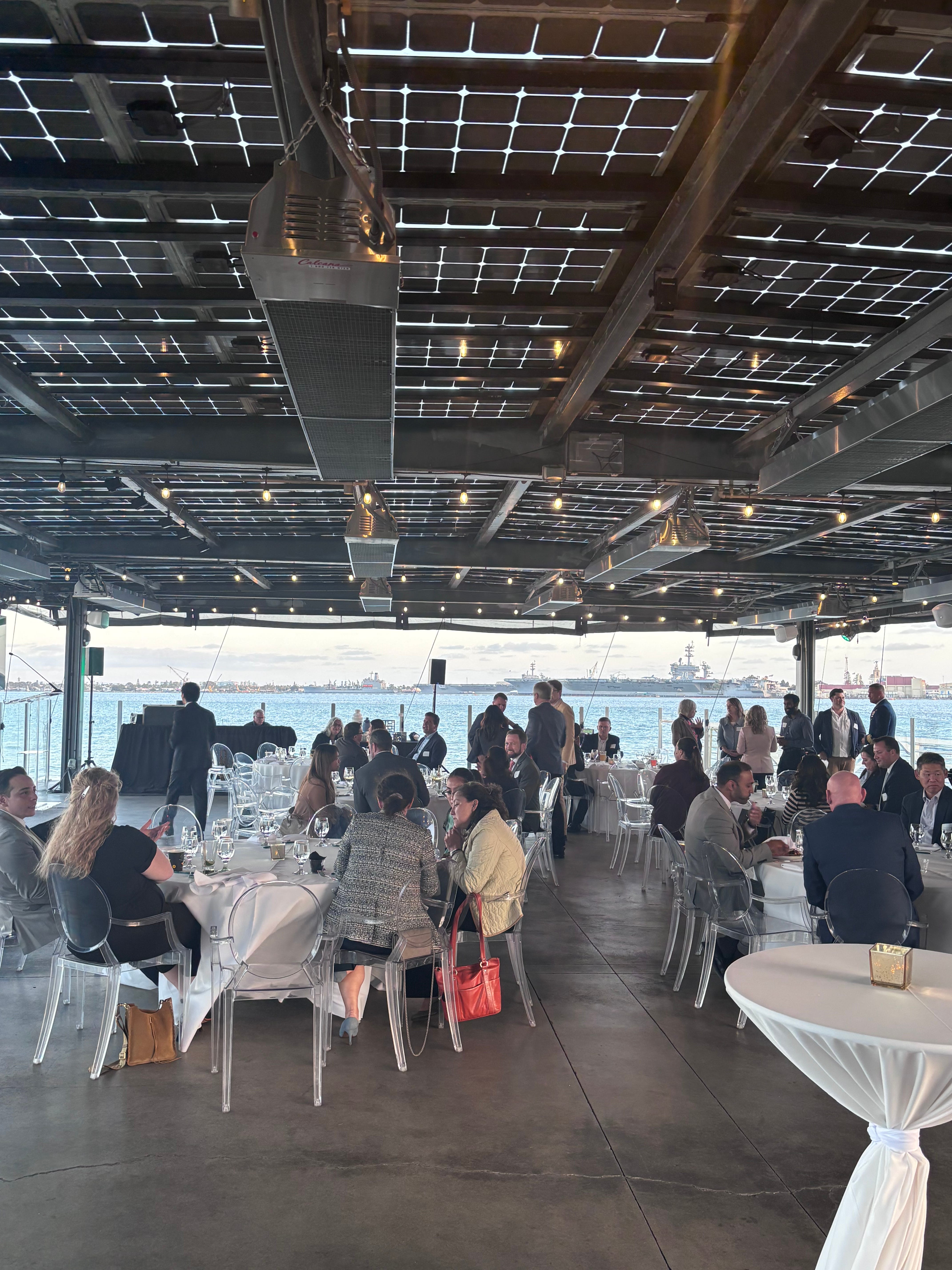
America's Strategic City forum at Coasterra — Photo: Connor Doyle
Overview
The La Jolla Center for Pacific Strategy held its inaugural America’s Strategic City forum at Coasterra on Harbor Island on the evening of May 28th, convening leaders from defense, public health, economic development, and ocean and climate research for a moderated panel discussion, open Q&A, and table conversations. The room included international diplomats, local national security leaders, industry executives, university leadership, local government representatives, and leaders in San Diego’s civil society.
Setting the Stage
The evening opened with a central argument: the international system, organized exclusively around nation-states with connectivity running primarily through capitals, no longer exists. In a world of globalized business and direct international communication, the state-to-state relationship is just one fiber in a broader network of international connectivity. Alongside it are additional channels comprising direct international relationships built through research partnerships, supply chains, travel, and civic engagement. Unique among cities, San Diego serves as a critical node within these networks. The work of The La Jolla Center for Pacific Strategy is to leverage San Diego’s unique visibility into those networks and surface what matters most, ensuring that Pacific policy is informed by those on the leading edge of the region’s most critical issues.
The event convened against a backdrop of cascading global crises — the very challenges San Diego’s strategic industries are uniquely positioned to address: the closure of a critical strait, threats to merchant shipping, major outbreaks of deadly diseases, emerging AI-driven biosecurity threats, intensifying competition for seabed minerals, and more. The human capital endemic to San Diego must have a home to approach these problems head-on, across disciplines and sectors.
Key Themes
The Collapse of Assumed Foundations
With every sector represented in the room, the story was the same: frameworks that held for decades are no longer holding. In public health, the apolitical nature of science-based federal agencies has broken down, with concrete consequences including persistent gaps in biosurveillance, the curtailment of the CDC’s international presence, the defunding of deployable medical epidemiologists, and the United States’ withdrawal from the WHO.
On the economic front, early AI deployment is producing productivity gains while cutting jobs across San Diego’s core innovation sectors, breaking from the arithmetic that reliably linked innovation industry growth to broad-based regional prosperity. In diplomacy, the assumption that the federal government would consistently maintain alliance relationships has given way to cities, universities, and individuals filling the gap by necessity.
San Diego as an Informal Diplomacy Hub
Speakers repeatedly returned to the idea that every person in the room serves as an informal diplomat, and that this role is no longer secondary.
Trust, participants argued, is the asset creating the margin for error that formal policy cannot provide; it is built like stonework over time, through consistent presence and personal investment. San Diego has an unusual concentration of people who have built exactly that kind of trust — through decades of military deployments, research collaboration, trade relationships, and civic engagement across Latin America and the Pacific.
San Diego’s civic leadership has started to internalize this. A decade ago, the mayor had not traveled internationally in 15 years. Today, that same office coordinates trade missions and a coherent regional strategy from home and abroad. Coincidentally, San Diego is celebrating 70 years of a sister-city relationship with Yokohama, Japan, this year, representing the kind of durable subnational tie that outlasts federal turbulence.
The Blue Economy and Research Diplomacy
San Diego’s ocean and climate research community has stepped into international spaces where federal presence has receded, showing up at global conferences and forums in numbers that surprised other delegations and reflected well on the region.
That presence is backed by real infrastructure. A local, regional coalition now brings together research universities, the Port of San Diego, the Coast Guard, the Navy, and a growing startup ecosystem into a regular cadence of coordination that enables solutions to reach end users far faster than when these institutions operated in isolation. The risk the panel flagged is that federal cuts to ocean and environmental monitoring programs threaten not only basic research but downstream applications in naval operations and homeland security that depend on this data.
Public Health as a Cross-Sector Risk
The County of San Diego has been building capacity in response to federal degradation, including in-house wastewater surveillance, new laboratory facilities, and real-time syndromic surveillance through emergency room data — all of which is being stress-tested ahead of a World Cup hosted across a region with the world’s largest land border crossing.
The Tijuana River Crisis, the only locally declared county emergency, was framed this evening as a shared binational burden rather than a border problem. Many contributing industrial sources are American companies, and many employees of San Diego County live in Tijuana and commute. A measles exposure at a downtown hotel the prior weekend illustrated the cascade in real time: overtime staff, canceled reservations, and families rerouting travel.
Foreign Investment and the Reshoring Moment
San Diego’s competitive advantage in global investment is research and development (R&D) density — including over 100 research institutes and a track record of first-in-the-world breakthroughs in genomics, mobile connectivity, and autonomous systems — that most of the world simply does not know about, as the region has historically been better at doing the work than telling the story. Most foreign investment enters the biotech and advanced technology sectors through mergers and acquisitions. Switzerland is now the top foreign investor, largely through a sequence of Novartis acquisitions culminating in a $1.5 billion R&D headquarters.
The evening’s speakers described the current environment as a genuine opportunity. Reshoring dynamics and supply chain restructuring are creating openings for regions that can coordinate well and connect R&D to prototyping and manufacturing — areas where San Diego has historically been weaker, but where the binational relationship with Tijuana can be leveraged. An additional crucial point was made: the Pacific includes Canada and Latin America, Mexico through Chile, not only the traditional Indo-Pacific frame.
Inclusion and the Risk of Being Left Behind
A question from the floor named something the room had been circling: as networks and relationships become the primary mechanism for opportunity, what happens to the communities already outside those networks? San Diego’s median home price is near $950,000, while the job base pays less than $55,000 for three-quarters of new positions. That mismatch is both a social equity problem and a talent retention problem.
Progress was acknowledged honestly: wages for Latino households are growing faster than any other demographic in the region, housing production is up, and more young people are entering high-demand fields than ever before. But the pace is not commensurate with the urgency.
Conclusion
The room at the America’s Strategic City forum reflected the evening’s argument. Around the tables were active and retired military officers, consuls general and professional diplomats, university leadership, founders and executives from San Diego’s defense and life sciences industries, public health officials, port and maritime leaders, and representatives from the region’s civic and nonprofit community. Several countries were represented directly in the audience.
What emerged from these conversations, both on the panel and at each table, was a shared sense that San Diego is at an inflection point. The region has spent decades building the relationships, institutions, and expertise that the current moment demands, often without recognizing that as a strategic asset. The federal retreat from alliance maintenance, global health infrastructure, and coordinated trade engagement is a problem, but for a city like San Diego, with its human capital and institutional depth, it is also an opening.
The La Jolla Center’s inaugural forum was a first step toward deliberately organizing these assets. The conversations that continued well after the event’s close suggested the appetite for such a convening is real.